






React Native Mobile Apps
One codebase, two app stores — mobile apps that extend the platform you've already built, not a rebuild from scratch.

A growing web platform with real customers and no mobile presence to match.
An app that feels like a website wrapped in a WebView — visible loading, no native gestures, none of the smoothness users expect from an app.
A mobile app that has to plug into an existing backend, CRM, and sales system, not exist as an island next to it.
One codebase. Two stores. No compromise on native feel.
One codebase, not two
React Native ships iOS and Android from a single TypeScript codebase — half the maintenance surface of separate native teams, without the compromises of a webview wrapper.
Feels native, because it is
No visible content loading in front of the user, native gestures, and smooth transitions between screens — the lag and jank of a wrapped website simply isn't there to hide.
Reaches what a webview can't
Camera-based QR and barcode scanning, biometric login, Apple Wallet, and rich push notifications with deep links into a specific screen — native capabilities a wrapped website has no access to.
Built to sit inside your existing stack
A mobile app rarely stands alone. Whether your backend is Laravel, Shopify, or something else, we design the API contract, auth, and data model to extend it — not fork it into a second system.
What you get

A single React Native codebase shipping to iOS and Android from day one, sharing types and business logic with your web stack where it makes sense.
Native-first integrations — push notifications with delivery history, social sign-in, deep links — built the way App Store and Play Store review actually expect, not the shortcut version.
A dedicated mobile API layer when your existing backend needs one, versioned and documented instead of improvised.

A release process built for real production use — the platform-specific hardening that decides whether an app holds up after launch, not just in the demo.
Mobile events wired into GA4 — or whatever analytics you already run — so app conversions and engagement sit next to your web data instead of living in a separate dashboard.
On Shopify? We connect through the Storefront API — the same product, inventory, and customer data already running your web store, now inside a native app, with no second source of truth to maintain.
Already running an app-builder wrapper?
Tapcart, Shopney, and similar tools get an app live fast — but they're templates, not products. If push notifications, loyalty, or checkout speed matter to your brand, the wrapper is usually the ceiling, not the starting point.
Real navigation, not a website in a frame.
Your catalogue, accounts, and orders stay exactly where they are — what changes is native routing and gestures instead of a WebView pretending to be an app.
A push system, not a broadcast list.
Segmented, native notifications with delivery history and deep links, instead of blasting everyone the same message.
Native APIs, not browser APIs.
Biometric login, Apple Wallet, camera-based scanning — capabilities a WebView can't reach no matter how it's configured.
Compliant by design, not by accident.
Apple's Guideline 4.2 (Minimum Functionality) is increasingly strict on apps that don't do meaningfully more than their website — native is the safer long-term bet for staying listed, not just the smoother one.
Is React Native the right call?
React Native is the right call when:
You need iOS and Android from one team and one budget, and can't justify two native codebases.
The app needs to extend an existing web platform and backend — accounts, catalogue, orders, loyalty — not exist as a standalone product.
Native features — push, deep links, social login — matter to the experience, ruling out a simple webview wrapper.
You want a codebase your own team can maintain long after launch, not a black box handed over once.
Consider something else if:
You need deep platform-specific capability — heavy AR/ML, complex background processing — on day one; a fully native build per platform may serve you better than a shared codebase.
Questions that come up before every build
How does the cost compare to an app-builder subscription?
App builders are cheaper month to month. A custom build costs more upfront and to maintain — the difference is only worth it if it moves a number you already track, like conversion, retention, or app store ratings. We'll help you work out whether that's likely before you commit to anything.
Can you migrate an existing wrapper app without starting from zero?
Yes — the data, accounts, and backend integrations don't need rebuilding, only the client. Most of discovery is figuring out what's reusable versus what needs a native equivalent.
What happens to our existing loyalty, subscription, or marketing app integrations?
Whatever has a usable API keeps working — Klaviyo, Recharge, Yotpo, and most Shopify-ecosystem tools integrate rather than get replaced. Anything without one gets flagged during discovery, so there are no surprises mid-build.
Why React Native instead of Flutter?
Both are solid choices for shipping iOS and Android from one codebase. We default to React Native mainly for the talent pool — JavaScript/TypeScript engineers are far easier to find and hand a codebase to later than Dart specialists, which matters once someone has to maintain the app after launch, not just ship it. Flutter draws its own UI instead of using native components, so it can look pixel-identical across platforms — a real advantage if that matters more to you than the platform-native feel we optimize for here.
How long does it take to build and launch a React Native app?
Depends what you mean. Proving the riskiest piece actually works — a payment flow, a tricky auth requirement — is often a matter of days, not weeks; that's the fastest way to get real confidence before committing to a full build. The complete build through store submission typically runs 11 to 18 weeks: 1 week of discovery, 2 to 3 weeks turning that proof-of-concept into a proper working prototype, then 8 to 14 weeks of build. A wrapper migration with reusable data and design tends toward the shorter end; a large catalogue or several custom integrations push it longer.
Do you handle App Store and Google Play submission?
Yes — developer account setup, store listing assets, and the actual submission for both platforms are part of the build, along with a phased rollout and on-call support through your first release cycle. If your current wrapper app has ever been flagged under Apple's Guideline 4.2 (Minimum Functionality), a native rebuild is what actually resolves that risk, not a resubmission of the same underlying app.
Who owns the code and the app store listings after launch?
You do. The repository, the App Store Connect and Google Play Console listings, and any backend services we build are yours outright — nothing sits inside an account we control or a subscription that stops working the day you stop paying us.
Do you build with Expo or bare React Native?
Expo, with EAS Build handling native builds and over-the-air updates — and it still drops down to native modules for anything that genuinely needs them. That's the full production setup, not a simplified version reserved for smaller projects.
Our process

1 week. We map the existing platform and API surface, and scope what the app needs from day one versus later.

2–3 weeks. A working app covering the riskiest native flow end-to-end — usually auth or payments.
8–14 weeks. Screens, API integration, push notifications, and the retention mechanics that keep people opening the app.

Store submission and an EAS build pipeline, phased rollout, on-call through the first release cycle.
One app, two stores. Let's scope the build.
A one-week discovery maps your existing platform and API surface, so we know exactly what the app needs from day one.

Selected work in this service
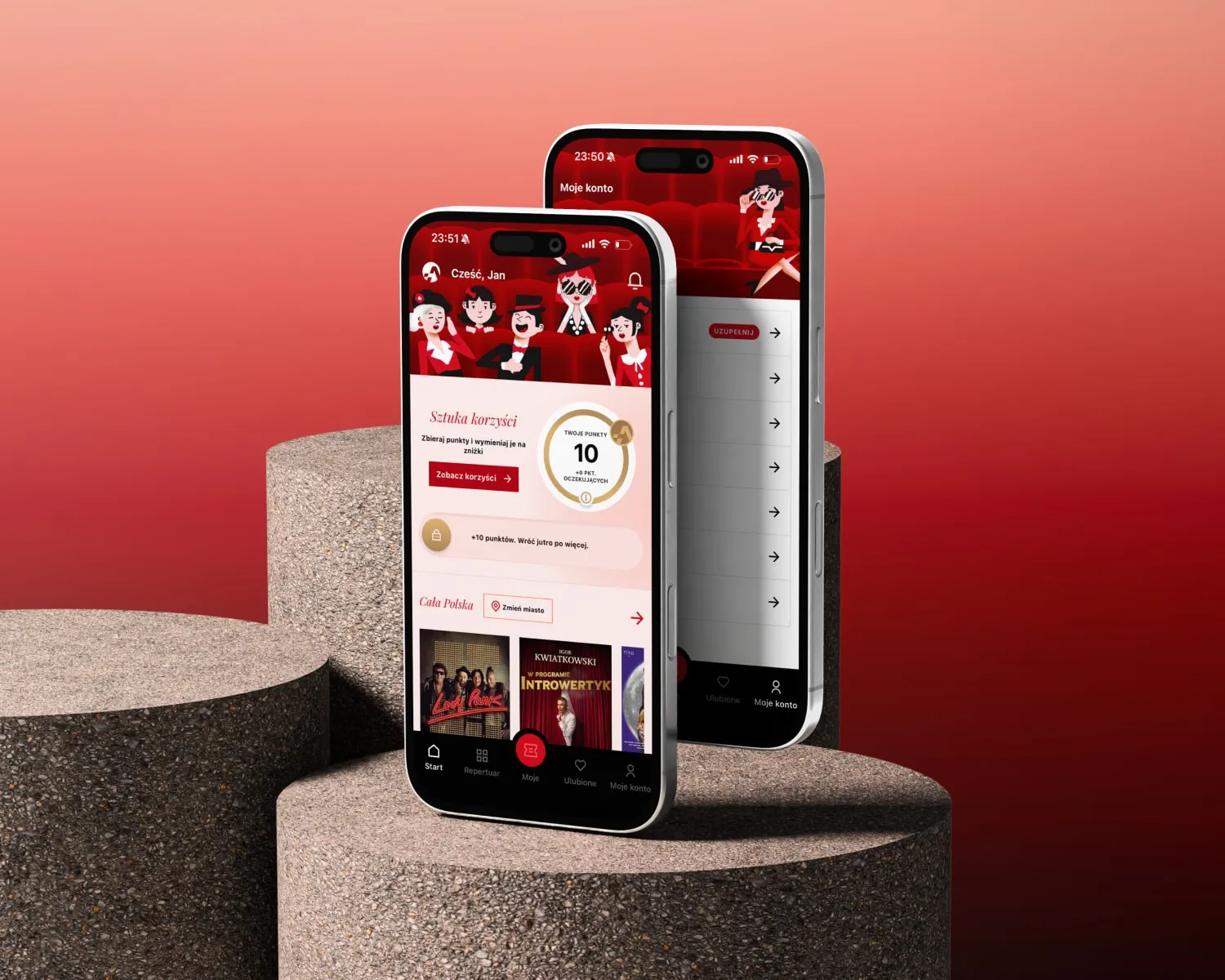
Adria Art Mobile App, View Case Study
A React Native mobile app extending Adria Art's ticketing and events platform with tickets, loyalty, and push notifications.